Referring Impedances
In a system with multiple voltage levels, it is sometimes necessary convert impedances from one voltage to another, i.e. so that they can be used in a single equivalent circuit. Note that the whole process of referring impedances can be avoided by using the per-unit system.
Referring Impedances in General
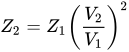
Generally, one can refer an impedance Failed to parse (Conversion error. Server ("https://wikimedia.org/api/rest_") reported: "Cannot get mml. Server problem."): {\displaystyle Z_{1}} at some voltage to another voltage Failed to parse (Conversion error. Server ("https://wikimedia.org/api/rest_") reported: "Cannot get mml. Server problem."): {\displaystyle V_{2}} by the following calculation:
- Failed to parse (Conversion error. Server ("https://wikimedia.org/api/rest_") reported: "Cannot get mml. Server problem."): {\displaystyle Z_{2}=Z_{1}\left({\frac {V_{2}}{V_{1}}}\right)^{2}}
Where is the impedance at voltage ()
- Failed to parse (MathML with SVG or PNG fallback (recommended for modern browsers and accessibility tools): Invalid response ("Math extension cannot connect to Restbase.") from server "https://wikimedia.org/api/rest_v1/":): {\displaystyle Z_{2} \, } is the impedance at voltage Failed to parse (Conversion error. Server ("https://wikimedia.org/api/rest_") reported: "Cannot get mml. Server problem."): {\displaystyle V_{2}} ()
Referring Impedances across Transformers
The winding ratio of a transformer can be calculated as follows:
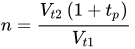
Where is the transformer winding ratio
- is the transformer nominal secondary voltage at the principal tap (Vac)
- is the transformer nominal primary voltage (Vac)
- Failed to parse (MathML with SVG or PNG fallback (recommended for modern browsers and accessibility tools): Invalid response ("Math extension cannot connect to Restbase.") from server "https://wikimedia.org/api/rest_v1/":): {\displaystyle t_{p} \, } is the specified tap setting (%)
Using the winding ratio, impedances (as well as resistances and reactances) can be referred to the primary (HV) side of the transformer by the following relation:
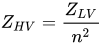
- Failed to parse (MathML with SVG or PNG fallback (recommended for modern browsers and accessibility tools): Invalid response ("Math extension cannot connect to Restbase.") from server "https://wikimedia.org/api/rest_v1/":): {\displaystyle Z_{HV} = \frac{Z_{LV}}{n^{2}} \, }
Where is the impedance referred to the primary (HV) side (Failed to parse (MathML with SVG or PNG fallback (recommended for modern browsers and accessibility tools): Invalid response ("Math extension cannot connect to Restbase.") from server "https://wikimedia.org/api/rest_v1/":): {\displaystyle \Omega } )
- Failed to parse (MathML with SVG or PNG fallback (recommended for modern browsers and accessibility tools): Invalid response ("Math extension cannot connect to Restbase.") from server "https://wikimedia.org/api/rest_v1/":): {\displaystyle Z_{LV} \, } is the impedance at the secondary (LV) side (Failed to parse (MathML with SVG or PNG fallback (recommended for modern browsers and accessibility tools): Invalid response ("Math extension cannot connect to Restbase.") from server "https://wikimedia.org/api/rest_v1/":): {\displaystyle \Omega } )
- Failed to parse (MathML with SVG or PNG fallback (recommended for modern browsers and accessibility tools): Invalid response ("Math extension cannot connect to Restbase.") from server "https://wikimedia.org/api/rest_v1/":): {\displaystyle n \, } is the transformer winding ratio (pu)
Conversely, by re-arranging the equation above, impedances can be referred to the LV side:
- Failed to parse (MathML with SVG or PNG fallback (recommended for modern browsers and accessibility tools): Invalid response ("Math extension cannot connect to Restbase.") from server "https://wikimedia.org/api/rest_v1/":): {\displaystyle Z_{LV} = Z_{HV} \times n^{2} \, }