Difference between revisions of "Simple Power Flow Example"
(Created page with "Consider the simple model shown in Figure 1, where a large stiff network supplies a constant power load <math>\boldsymbol{S} \, </math> through an impedance <...") |
|||
| Line 65: | Line 65: | ||
: <math>||Z_{s}|| = \frac{V^{2}}{S_{SC}} = \frac{33kV^{2}}{800MVA} = 1.361 \Omega \, </math> | : <math>||Z_{s}|| = \frac{V^{2}}{S_{SC}} = \frac{33kV^{2}}{800MVA} = 1.361 \Omega \, </math> | ||
| − | Converted to per-unit values (on a | + | Converted to per-unit values (on a 100 MVA base): |
| − | : <math>||Z_{s,pu}|| = \frac{||Z_{s}||}{Z_{base}} = \frac{1.361}{ | + | : <math>||Z_{s,pu}|| = \frac{||Z_{s}||}{Z_{base}} = \frac{1.361}{10.89} = 0.125 pu \, </math> |
For an X/R ratio of 10, the source impedance is therefore: | For an X/R ratio of 10, the source impedance is therefore: | ||
| Line 77: | Line 77: | ||
: <math>\boldsymbol{S_{pu}} = 0.5 - j0.375 pu = 0.625 \angle -0.6435 \, </math> (angle in radians) | : <math>\boldsymbol{S_{pu}} = 0.5 - j0.375 pu = 0.625 \angle -0.6435 \, </math> (angle in radians) | ||
| − | Plugging the parameters <math>S = 0.625 \, </math>, <math>Z = 0. | + | Plugging the parameters <math>S = 0.625 \, </math>, <math>Z = 0.125\, </math>, <math>\phi = -0.6435 \, </math> and <math>\theta = 1.471 \, </math> into Equation (1), we get the load bus voltage: |
| − | : <math>V_r = 0. | + | : <math>V_r = 0.9433 pu \, </math> |
== Intuition for General Power Flow Solutions == | == Intuition for General Power Flow Solutions == | ||
Latest revision as of 23:03, 23 April 2026
Consider the simple model shown in Figure 1, where a large stiff network supplies a constant power load through an impedance :


Suppose the load power is known and we want to calculate the load bus voltage . Unfortunately, this cannot be computed in a straightforward manner because the load is of constant power and thus the load current and impedance are voltage dependent, i.e. the load draws more current as voltage decreases. As a result, the load bus voltage is non-linearly related to the load itself.

Derivation of the Load Bus Voltage
Note that in this derivation, all quantities are in per-unit. Recall that the load complex power can be calculated from the voltage and current phasors as follows:

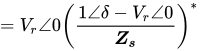
Suppose that we represent both the load power and impedance in polar coordinates, i.e.


Then the power equation can be re-written as:
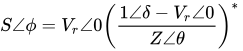
Conjugating the terms in brackets and simplifying, we get:


Applying Euler's law, we get:
![{\displaystyle SZ\left[\cos(\phi +\theta )+j\sin(\phi -\theta )\right]+V_{r}^{2}=V_{r}\left[\cos(\delta )+j\sin(\delta )\right]\,}](https://wikimedia.org/api/rest_v1/media/math/render/svg/38f04d3306039390ca54522744e365756ec9fad4)
Separating the real and imaginary terms of the above equation:


Squaring both equations and summing them together, we get:
![{\displaystyle \left[SZ\cos(\phi +\theta )+V_{r}^{2}\right]^{2}+(SZ)^{2}\sin ^{2}(\phi +\theta )=V_{r}^{2}\cos ^{2}(\delta )+V_{r}^{2}\sin ^{2}(\delta )\,}](https://wikimedia.org/api/rest_v1/media/math/render/svg/ba0944116eeaf588326888745d7769e18cdabda5)
Simplifying and re-arranging the equation above, we can get the following homogenous equation:
![{\displaystyle V_{r}^{4}+\left[2SZ\cos(\phi +\theta )-1\right]V_{r}^{2}+(SZ)^{2}=0\,}](https://wikimedia.org/api/rest_v1/media/math/render/svg/c5831676cdba35fae2636eed655b8f3841f9ef2a)
This equation can be solved for the load bus voltage using the quadratic formula:
- ... Equ. (1)
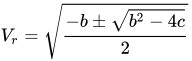
Where

and

Worked Example
Suppose that the source bus has a nominal voltage of 33kV and a short circuit level of 800MVA at X/R ratio of 10. What is the voltage at the load bus if it is supplying a constant 50MW load at 0.8pf (lagging)?
The source impedance is:

Converted to per-unit values (on a 100 MVA base):

For an X/R ratio of 10, the source impedance is therefore:
- (angle in radians)

The 50MW load converted to per unit is (by convention, a load with lagging power factor has a negative reactive power):
- (angle in radians)

Plugging the parameters , , and into Equation (1), we get the load bus voltage:





Intuition for General Power Flow Solutions
We saw in this simple example that the power flow problem for constant power loads is non-linear (i.e. quadratic) and cannot be solved with linear techniques. This intuition can be extended to more general power flow problems. While a closed form solution was found for this simple case, the general power flow problem is typically solved using iterative numerical methods, for example a Newton-Raphson algorithm.